2014年7月12日土曜日

”Nasebanaru - Where There is a Will, There is a Way."

"なせば成る なさねば成らぬ 何事も 成らぬは人の なさぬなりけり"
 (nasebanaru nasanebanaranu nanigotomo naranuwahitono nasanunarikeri)
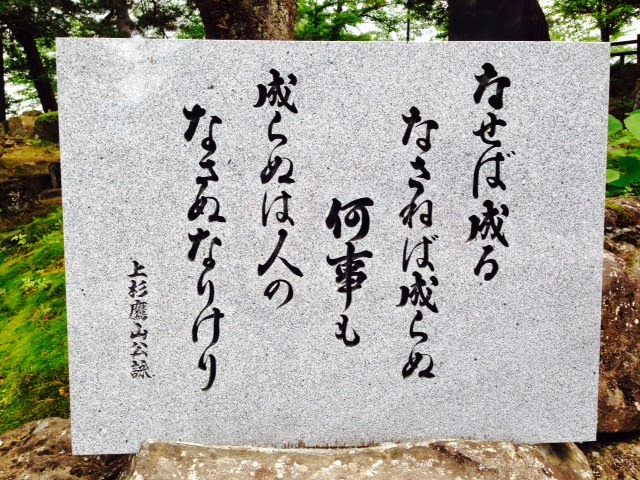


 This is a famous Japanese proverb. However, if foreigners hear the phrase, they may think it as a magical spell. I came across this phrase during a visit to Yonezawa City located in south east of Yamagata. 
This phrase is a "tanka" and was composed by Uesugi Yōzan. (Tanka is a classical Japanese poetry and consist of five lines in the pattern 5-7-5-7-7 syllables.)


 Uesugi Yōzan was a "daimyo" (Japanese feudal lord), the ninth lord of the Yonezawa Domain of Dewa Province. The pictures show the statue of him. By the Mid-Edo Period (1600-1868), Yonezawa Domain had incurred enormous debt. Uesugi gained a good reputation as a wise ruler who made a great effort to pay back the debt. Surprisingly, John F. Kennedy also respected him.


 He undertook two famous reforms called "質素倹約 shisso kenyaku (Simplicity and Frugality)" and "殖産興業 shokusankogyo ( Encouragement of New Industry)." Simply put, they mean "Save Money, and Make a Profit." He himself reduced his cost of living to two sevenths to promote these reforms. He also encouraged the cultivation of mulberries and the silkworm-raising industry (sericulture). Then, he encouraged the silk industry to develop the nationally famous silk fabric called "Yonezawa Ori".


 Yonezawa Ori is very fine and beautiful. I visited the studio in the Yonezawa city. There was a lot of raw silk dyed with various tree and flower dyes, such as safflower and cherry.This natural color captured my heart. 


 Strolling in Yonezawa City, I came upon this. That's an "Edible Fence." This is ukogi plant. Uesugi Yozan hit upon an idea to eat ukogi as an emergency food. It's eaten as a tempura or ohitashi.


 I read, "Ukogi is rich in vitamin" on the explanation boards, and tried to eat it. "Ukogi soft ice cream! Yeah!" It has a savory flavor of tea leaf and a light sweetness. "Fantastic!"


 Well, I'll  introduce you the meaning of the proverb that I wrote at the beginning of the blog. It literally means "If you try to do, it can be achieved. If you don't, it will never be achieved. Achieving nothing is due to your own intention to not try." It comes to the same as the English proverb, "Where there is a will, there is a way." Of course, if you are living in a distant foreign country, would be difficult to visit Uesugi Shrine directly. So, I show you the photo of Uesugi shrine. You'll be able to feel the sanctity of the shrine as if you are in there.


 Please do your best, I hope your wish will come true.


Uesugi Shrine:

1-4-13, Marunochi, Yonezawa-city, Yamagata, 992-0052, Japan
http://www.yonezawa-kankou-navi.com/langage/en/index.html

Dyeing and weaving studio, "Wakuwaku Kan":

1-2-37, Gobyo, Yonezawa-city, Yamagata, 992-0055, Japan
http://www.wakuwakukan.co.jp/

2014年7月7日月曜日

The Beautiful Ladies and the Delicious Ramens of the Cherry Kingdom.

 When you hear the name "The Cherry Kingdom", where do you imagine it is? To see the kingdom, I rode the highway bus and the local train, and went to the Tohoku region of Japan, which is in the northeast area of the main island. From there, I went further into the countryside, and I was alone in the empty carriage.


 I could see only mountains and rice fields from the train window. This was a good opportunity for some alone time to think. 


 I finally arrived at the cherry kingdom "Yamagata" after over 13 hours by bus and train.


 So, why is Yamagata the cherry kingdom? The crop yield of cherries in Yamagata total about 14,300 tons per year and it is the best in Japan. I found cherries at an outdoor stand around the station. They were just like gems! Sparkling like rubies! Well, let's see... 5,000 yen per kilogram!? :-O That was too expensive for me.


 Using my head, I decided to find cheap and delicious foods. So, let me introduce to you another Yamagata speciality that's No. 1 in Japan! It is the consumption of Chinese noodles in the region. People in Yamagata eat ramen really frequently. Ramen is a part of their cuisine. Accordingly, various unique ramen dishes, such as "Hiyashi Ramen" (Cold Ramen) and "Torimotsu Ramen" (Chicken Offal Ramen) have been created. These are ramen I ate during my stay.


"Hiyashi Ramen" (Cold Ramen): The Hiyashi Ramen I ate was topped with wood ears. The soup base with soy sauce was refreshing, and the wood ear had firm texture. It looked flowery and cool. Which is perfect for summer.


 "Shio Tonkotsu Ramen" (Salted Pork Bone Broth Ramen): Simple salty tonkotsu soup and burnt oil make a superb combination. The tonkotsu soup stimulated my appetite and I slurped all the noodles in one gulp. It was a rainy, chilly evening, but I felt warm eating this ramen.


 "Yamagata Soba" (Yamagata Buckwheat Noodles): In addition to the ramen shops, Yamagata has many soba noodle shops. I ate this in front of the station. The meat of duck is soft and I think it complements the soba.


  Huh? So where are the beautiful ladies?

 OK, let me show you Yamagata beauties!Ta-dah! Maiko Han!!! 


 Their skins were very white and clean, and the contrast between their skin and their gorgeous kimonos was very fascinating.


 Next, this smiling beauty, "Hanagasa-odori". This traditional dance uses the elegant Hanagasa (flower hat) adorned with artificial flowers. Their vivid expressions attract people.


 Yamagata was just in the middle of a sightseeing campaign. Accordingly, the beautiful ladies warmly welcomed tourists at JR Yamagata Station. Even so, Japan is a really unique and interesting country!


"Sakai": I ate a Hiyashi Ramen in this shop.

1-7-34, Honcho, Yamagata-city, Yamagata, 990-0043, Japan

"Guranfa": I ate a Shio Tonkotsu Ramen in this shop.

2-2-40, Kasumicho, Yamagata-city, Yamagata, 990-0039, Japan

"Yamaguchi Seiniku Seimen Center:I ate a Yamagata Soba in this shop.

1F, Ekinan Bld., 1-2, Saiwaicho, Yamagata-city, Yamagata, 990-0038, Japan"

2014年7月5日土曜日

Kyoto is the Best Place to Engross Yourself in Comics!

 Kyoto is famous for its shrines and temples. However, Kyoto has some more places you should visit. "Kyoto International Manga Museum" is one of those places.
 
 Not only does it have popular modern comics, it also has historical materials, such as magazines from the Meiji era and rental books of the postwar period, and masterpieces from around the world. In all, this museum has a collection of about 300,000 comics. In old time, comics were very expensive, corresponding to about 2,000 yen per comic in today's money. A book rental shop has the same system as a CD rental shop does nowadays. Children borrowed comics at cheaper prices, and read various stories. The museum is actually an elementary school that has been reconstructed, and I love its retro atmosphere.


 You can also see the professional work of a cartoonist nearby and experience various activity corners.


 I went to the portrait experience corner and got my manga character done by an artist.


 This is my original manga character "Ninja Toramon" painted by him. "Tora" means a tiger. Because I was born in the year of the tiger and am a Tigers fan, my mascot character is a tiger girl. This is my favorite! It was such a memorable event!


 In the museum, I had another impressive encounter. It was a "Kamishibai" picture-story show.


 Picture-story shows were thriving from around 1930 to 1960. As TVs became common, it has been in decline. According to my parents's story, children clasped coins in their hands and gathered around the picture-story show caravans. To see the show, they had to buy cheap candy as their admission fee. In the old days, a storyteller of a picture-story show required a license.


 The attraction of the picture-story show is that audiences can enjoy a story and its accompanying drama at the same time and in the same place. I was also enamored with the show.


 Cartoonists, artists and storytellers, I could meet a lot of young talent in this museum. It was really exciting. In this elementary school, you will never be scolded for reading comics. Let's read comics now!


"Kyoto International Manga Museum"

Kinbuki cho 452, Nagakyo-ku, Kyoto city
http://www.kyotomm.jp/english/

2014年7月4日金曜日

Records of My Travels in Okinawa ~vol.5 Okinawa Souvenirs~

 In Okinawa, you can buy unique souvenirs. For example, have you ever tried drinking "Hub sake"? 


 Hub is a highly toxic snake living in Okinawa. This sake is created by catching a hub alive and soaking it in awamori, the strong Okinawan liquor. If you give hub sake to your friends, they will surely be surprised! It's guaranteed to go over well.

 The next souvenir I recommend you to get is "dragon fruit". Its bright red pericarp actually looks like a dragon's scale! While traveling, I often look around the markets, because I want to understand local eating habits.


 I bought a dragon fruit and tried to eat it at home.


 After cutting the dragon fruit, blood-red juice dripped from kitchen knife.  I conjured up horrifying visions of the cutting board covered in blood instead... Luckily, it was only juice :-D


 The dragon fruit was refreshing and slightly sweet. I thought that eating it with honey made it more delicious.


 The most popular souvenir among my family was "Sata andagi", Okinawan black sugar doughnuts.


 The surface is  crispy and the inside is fluffy. There are various flavors such as black sesame seeds and coconut in addition to the brown sugar taste. Would you enjoy tasting the pastries with the dragon fruit juice in a café? 


 In addition to these souvenirs, there are ornaments of the legendary beast Shiisa, colorful Ryukyu glasses and more.. Okinawa is full of souvenirs that appeal to the travelers' sense of fun.


 You can buy these souvenirs at Kokusai Street. Try to find a nice treasure specially for you.


Kokusai-dori
1,Makishi, Naha-city, Okinawa, 900-0013, Japan